

An Interview by Paul Baumann
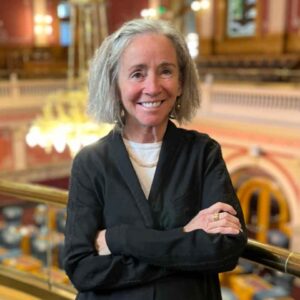
For this issue of Policy Perspective, I had a conversation with Senator Judy Amabile (D-Boulder), a member of the Colorado General Assembly Joint Budget Committee (JBC). A primary responsibility of the JBC is to prepare the state’s budget for consideration by the Colorado House and Senate. Since the state is facing a budget shortfall of over $1 billion, the JBC will be making numerous budget cuts, including significant cuts to Medicaid. Senator Amabile and I focused our conversation on this issue of importance for Colorado’s disability community.
We have heard that significant cuts to Medicaid in Colorado are necessary and cannot be avoided. Can you please help us understand why this is the case?
We have a situation where Medicaid costs are growing a lot faster than our population plus inflation. It’s growing too fast for us to keep up without surpassing TABOR caps and crowding out everything else. “If we don’t do something, within a few years Medicaid costs will crowd out everything else in the budget.”
Colorado has expanded Medicaid benefits beyond what some other states do, and these expanded benefits are beyond what we can cover. For example, we pay family caregivers. Few states do this, and it results in fewer providers available through agencies in our state. Family caregivers may be better for many individuals, but we also need a provider network for people without family caregivers available to them.
Overall, we are not cutting people off from Medicaid, we are “just slowing growth… but to families, that’s a distinction without a difference.”
What are your priorities for Medicaid budget cuts? What should be preserved? Why?
I want to be sure “that we are spreading cuts across recipients… not all directed at one group.” It’s also important to me to make cuts “in a way that allows people to get the services they need to keep their kids healthy.”
I am particularly concerned about maintaining “robust mental health care” as a part of Medicaid. “I don’t want to go back to how it was, even 5 years ago.”
Would you please expand on that?
“There are smarter ways” for Colorado to go about providing mental health services. Right now, the state has mental health programs for teachers, for police, for children, for all these groups, and they all operate independently. I’d like for us to set up a “mental health system that serves all groups.” Take a look at other medical specialties, like cancer care. “There’s no cancer care that is only for the police, or children, or anyone else… Cancer care is cancer care.” We need that for mental health.
Mental health also has “parity problems” with other healthcare areas, even though the law says that reimbursement for mental health and substance use treatment services must be treated equally to physical health services.
We also have to be sure that we are spending Medicaid dollars effectively. For example, “talk therapy is often considered something that anyone can do. That’s not true.” Talk therapy requires deep expertise. “Not everyone can do it.” We need to recognize that when funding mental health services within Medicaid.
What would you like to say to an individual or family who faces uncertainty because of these cuts? How can they ensure their voices get heard in the budget process?
We need a plan from the Department of Health Care Policy and Financing (HCPF)—and a plan for a rollout. Announcing cuts day by day does not work. Families need time to be able to plan and “make adjustments… My heart breaks for these families.” They need some level of certainty.
We appreciate families showing up at hearings. “They make a difference.” So does meeting with legislators in person. Legislators and their staff are genuinely feeling for these families.
How can Colorado protect the long-term stability of Medicaid? Has HCPF presented a plan and are you satisfied with that plan?
We have seen “pieces of a plan” from HCPF, “but that’s not a plan… They are looking at different ways to roll things out.”
Members of the JBC “are trying to be thoughtful about what we are doing.” So is HCPF. “We are listening. We are hearing. We are making adjustments. At the end of the day, it is hard. It’s going to hurt.”
I appreciate the disability rights groups that have come to the table. They have helped us identify which cuts would be most harmful, and which would be less harmful.
What would you like to see as part of a Medicaid sustainability plan from HCPF?
I would like to see Colorado consider “utilization management tools” that help us control costs for the rest of the Medicaid population. An example of this could be a copay for certain types of services. This would encourage choices that save costs. For instance, a $10 copay for emergency room visits would likely encourage people to see a doctor in their office prior to needing an emergency room visit. That’s a significant cost savings. “We’re not doing that in Medicaid. We need to be creative.”
I would like to consider reorganizing HCPF, the Department of Human Services, and several other offices to promote efficiencies and less “siloing.” These departments all work independently but often on very similar concerns for clients. Better coordination would ensure efficiency where it is possible, which would bring about better care. “It’s not organized in the best way possible.”
Yes, there’s administrative bloat, fraud, abuse. We’re working on addressing these, which will bring some savings. But these savings alone “won’t bend the curve” enough to solve the shortfall we face.
As these and other bills move forward, a key part of committee hearings is public testimony. We encourage you to provide testimony for bills that are important to you. Look here to sign up to testify in person, remotely, or in writing.

Policy Perspective is a publication of ADVOCACYDENVER. If you have any questions, please contact Paul Baumann, Policy Outreach Specialist, at pbaumann@advocacydenver.org or 303.974.2535.